Published on Sep 24, 2026
Tamil Nadu’s Green Schools show how climate education, cool roofs and clean energy reshape learning spaces.
On a sweltering summer afternoon in Tiruvallur district, R. Sivanandanam, Headmaster of Kollumedu Government High School, speaks with unmistakable pride about a transformation that has reshaped everyday life on his campus.
“I am proud to say that our school has received the Green School Certificate from the Government of Tamil Nadu,” he says. Kollumedu Government School was recognised under Phase II of the Tamil Nadu Green School Scheme, implemented by the Department of Environment and Climate Change under the Tamil Nadu Climate Change Mission in coordination with the School Education Department.
For Sivanandanam and his students, the recognition is not merely symbolic. It marks a decisive shift in how the school manages water, energy and heat—three pressures that increasingly define life in a warming Tamil Nadu.
“For years, we struggled to ensure decent potable water within the school premises,” he recalls. The Rs. 20-lakh grant awarded under the Green School Scheme proved transformative. Rainwater harvesting structures, a bore well and motor, and rooftop solar panels were installed in quick succession. “Within three months, we saw a clear improvement in groundwater levels,” he explains. “Today, all school blocks enjoy good drinking water and the we are also able to use the water for the school vegetable gardens.”
Kollumedu’s experience mirrors trends documented in a January 2026 impact study by the Indian Institute for Human Settlements (IIHS), which evaluated 97 Green Schools across Tamil Nadu. The study found that 79 per cent of schools had initiated rainwater harvesting, while 57 per cent adopted drip irrigation, significantly improving water security on campuses in a water-stressed locality.
However, the most immediate and visible change at Kollumedu came in June 2025, when the school buildings were covered under the state’s Cool School (Cool Roof) initiative.
“The cool-roofing effort has been a great success,” Sivanandanam says. “Our students are much more comfortable now, especially during the summer months.”
Tamil Nadu has declared extreme heat a state-specific disaster, acknowledging the serious health and learning impacts of soaring temperatures. In many government schools, indoor classroom temperatures routinely touch 38–40°C, affecting students’ concentration and wellbeing. Cool roofs are heat-reflective coatings applied to concrete rooftops, and offer a low-cost, scalable solution by reducing indoor temperatures without relying on energy-intensive cooling.
A pilot at Perunthalaivar Kamarajar Government Girls Higher Secondary School in Kizh Ambattur, Chennai, demonstrated a 1.5°C to 3°C reduction in indoor temperatures, prompting the state to expand the initiative to 297 Green Schools, as announced during the third Governing Council on Climate Change recently.
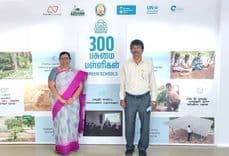
At Ambattur Government Higher Secondary School, Headmistress S. Vanitharani is confident that more benefits will soon be felt. Vanitharani and Sivanandanam received the Green School certification for their respective schools on January 19, 2026, from the Minister for School Education in the presence of the Minister for Finance and Environment, Government of Tamil Nadu.
“The grant allowed us to think beyond isolated improvements,” Vanitharani shares. The school has installed solar panels, rainwater harvesting systems and a bore well, and developed a vegetable and fruit garden that students actively maintain. “We also conduct regular awareness sessions on climate change and environmental protection. These conversations are now part of daily school life.”
The school was cool-roofed two months ago, and expectations are high. “During summer, outside temperatures can go up to 42 degrees Celsius,” Vanitharani explains. “Earlier, the humidity inside classrooms was unbearable. Now, with all four blocks cool-roofed, students will be able to relax, concentrate better and stop feeling constantly tense because of the heat.”
These local stories form part of a larger, integrated climate education and resilience strategy being rolled out by the Government of Tamil Nadu through the Environment and Climate Change. Alongside the Green School Scheme and Cool School initiative, the state is launching a Climate Education Initiative, described as a first-of-its-kind residential programme to train 4,000 teachers in climate literacy, experiential learning and environmental leadership.
The intent is clear: climate action in schools is not limited to infrastructure, but embedded in pedagogy.
The IIHS study underscores this approach, describing the Green School Scheme as primarily a climate literacy programme, with infrastructure serving as a learning tool rather than an end in itself. Campuses are treated as “living laboratories” - where students observe, measure and reflect on energy use, water cycles, waste flows, land use and biodiversity.
Energy outcomes from the scheme are already significant. Analysis of electricity bills from 49 Green Schools shows that average grid electricity consumption fell from 607.7 kWh to 328 kWh per month after solar installations—a 46 per cent reduction. Annually, each school saves about 3,572 kWh, translating to Rs. 26,000 in electricity cost savings, while generating an additional 1,350 kWh of solar power on site.
Scaled across the 297 Green Schools currently covered, these savings represent a substantial reduction in public electricity demand. The study estimates that extending similar interventions to all 45,000 government schools in Tamil Nadu could offset electricity consumption equivalent to 91 per cent of the annual usage of government educational institutions and hospitals, comparable to avoiding the need for a 100 MW solar power plant.
Beyond numbers, behavioural change is emerging as a defining outcome. Nearly 62 per cent of schools have initiated waste segregation, about half have composting pits and gardens, and many display green boards, murals and student-led climate messages. From vermicomposting to plastic-free pledges, students encounter climate solutions in their everyday routines.
Together, the Green School Scheme, Cool School initiative and Climate Education Initiative signal a deliberate shift in Tamil Nqadu’s climate strategy—one that places children, teachers and schools at the heart of resilience planning.
As classrooms become cooler, campuses more resource-secure and students more climate-literate, Tamil Nadu is quietly demonstrating that climate action does not always begin with megaprojects. Sometimes, it begins on a school rooftop, in a garden bed, or with a teacher helping students understand how their everyday choices shape the future.
Photo Gallery